Recovering from Hockey Injuries with Swiss DolorClast® Radial Shockwave Therapy Hockey demands repeated bursts of speed, powerful strides and quick changes of direction.
Over a long season, those movements can place considerable stress on muscles, tendons and other soft tissues. When persistent pain begins to affect skating, training or everyday movement, recovery requires a treatment plan that addresses both symptoms and physical function.
For certain musculoskeletal conditions, Swiss DolorClast® radial shockwave therapy may be part of that plan. Used alongside rehabilitation exercises and appropriate adjustments to activity, it offers a non-invasive treatment option for players managing ongoing soft-tissue pain.
Where Shockwave Therapy Fits into Hockey Rehabilitation
Hockey injuries can develop suddenly during a collision or gradually through repetitive loading. These situations require different approaches. A player with a recent traumatic injury needs an assessment before beginning treatment, while someone with persistent tendon pain may benefit from discussing shockwave therapy with their healthcare professional.
EMS identifies conditions such as Achilles tendinopathy, plantar fasciopathy, patellar tendon problems and certain shoulder and elbow tendinopathies among the conditions addressed within its Guided DolorClast® Therapy approach. Whether treatment is appropriate depends on the diagnosis, injury stage and individual assessment. ems-dolorclast.com.au
For hockey players, the practical goal is to restore tolerance for the demands of the sport: pushing off, stopping, turning, shooting and maintaining control throughout a shift.
What Is Swiss DolorClast® Radial Shockwave Therapy?
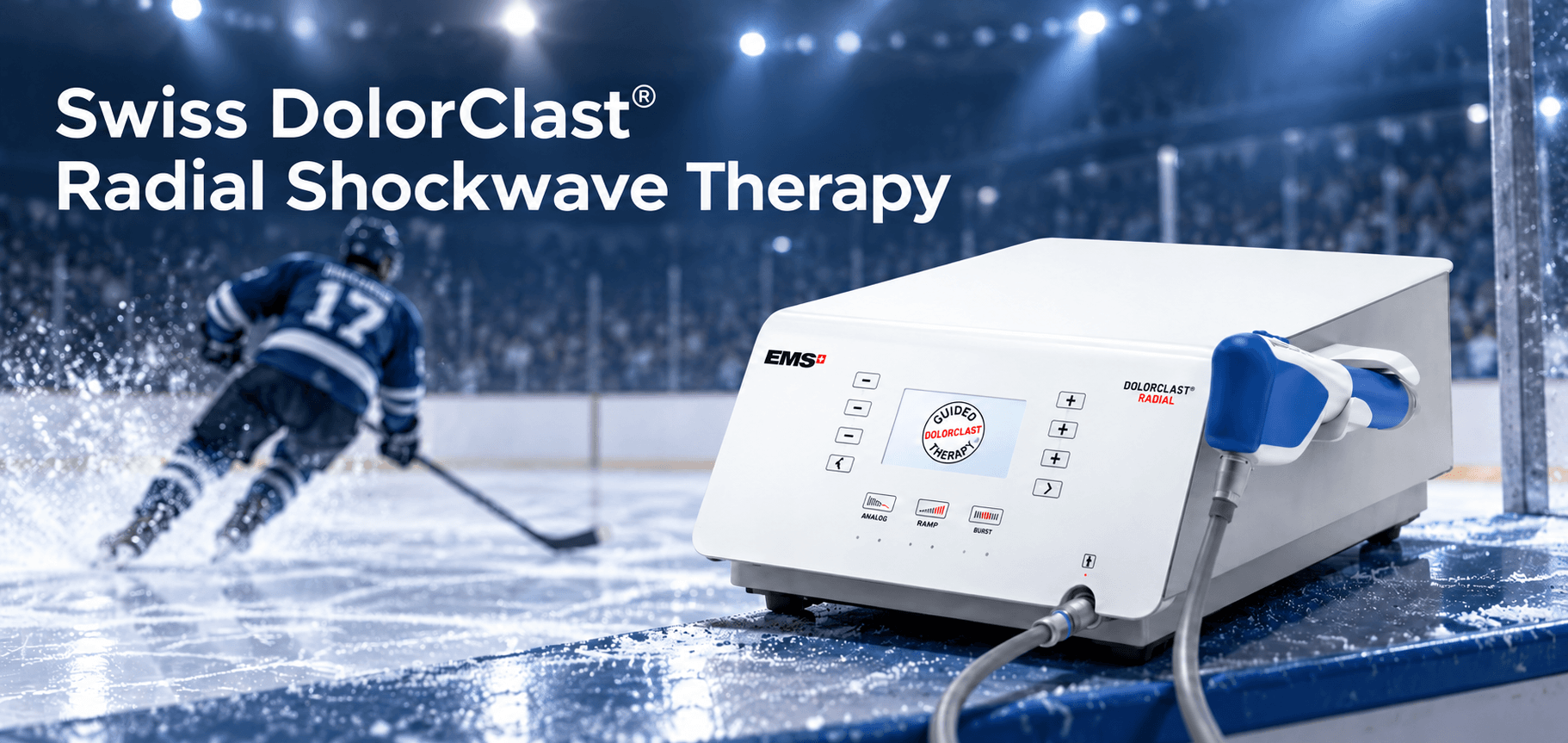
Swiss DolorClast® radial shockwave therapy delivers mechanical pressure pulses through an applicator placed against the skin. It is used to treat selected musculoskeletal conditions, particularly persistent pain involving relatively superficial tissues. Treatment is non-invasive and does not involve an incision. ems-dolorclast.com
The EMS DolorClast® Radial Shock Waves system allows practitioners to adjust treatment settings and choose different applicators. Its integrated compressors deliver impulses at frequencies of up to 25 Hz, giving clinicians flexibility when treating different areas. These features support treatment delivery; they do not determine how quickly an individual player will recover.
Addressing Persistent Pain That Interferes with Skating
Pain around the heel, Achilles tendon or knee can make a powerful skating stride difficult to maintain. Even when a player can finish a practice, recurring symptoms may affect their confidence and willingness to load the affected area.
For an appropriately diagnosed condition, a clinician may consider radial shockwave therapy to help manage symptoms while the player works through rehabilitation. For example, EMS references clinical research supporting radial shockwave treatment for chronic plantar fasciopathy. That evidence concerns a specific condition and should not be interpreted as proof that shockwave therapy treats every cause of foot pain or every hockey injury.
An accurate diagnosis helps distinguish a potentially suitable soft-tissue condition from an injury requiring a different treatment pathway.
Combining Treatment with Active Rehabilitation
Successful rehabilitation involves rebuilding the capacity needed for hockey. A player may need to improve strength, mobility, balance or tolerance for repeated effort before returning to full participation.
EMS incorporates prescribed rehabilitation exercises into its Guided DolorClast® Therapy approach, alongside assessment, treatment and follow-up. Shockwave therapy is therefore one component of a broader recovery process. ems-dolorclast.com.au
For a hockey player, that process might progress from controlled strengthening to skating drills, harder changes of direction and eventually full practice. The progression should reflect the injury and the player’s response to increasing demands.
Returning to the Ice with a Plan
Feeling less pain is encouraging, but it does not automatically mean a player is ready for unrestricted hockey. Recovery also involves being able to perform sport-specific movements and tolerate an increasing workload.
Treatment decisions and return-to-play planning should be individualized. There is no single number of shockwave sessions or guaranteed recovery timeline that applies to every athlete.
Learn More About Swiss DolorClast® with Magne-tec
For clinics supporting hockey players, Swiss DolorClast® radial shockwave therapy offers an option to consider within a comprehensive musculoskeletal rehabilitation service.
Contact Magne-tec to learn more about the EMS DolorClast® Radial Shock Waves system and its applications in clinical practice.
Call: 1-800-657-6009
Email: info@magne-tec.com